Why Cheap Office Chairs Sink (And What It Does to Your Back)
The 20-minute sink
You set the chair right. Feet flat, screen at eye level. That brief moment where the setup actually feels good, and then you get to work.
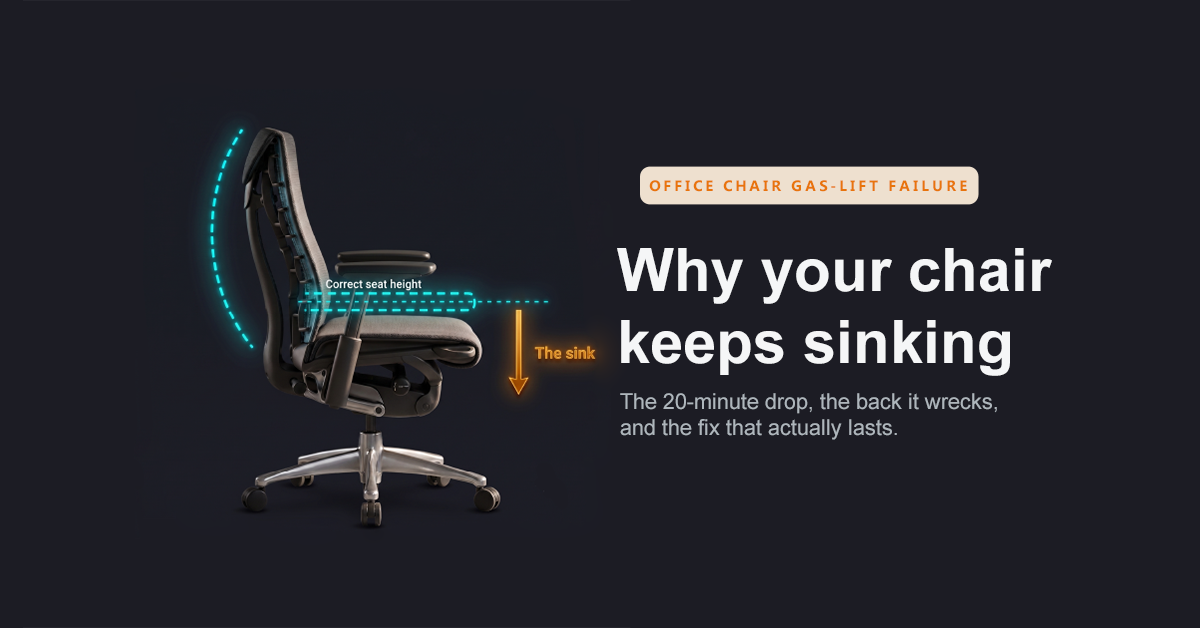
By the time you look up, you’re lower. Not dramatically. Just enough that your elbows don’t meet the desk the way they did, so you hike your shoulders a little to make up the gap. You reach down, yank the lever, ride it back up. Twenty minutes later you’re doing it again.
That’s the sink. Once a cylinder starts going, it doesn’t stop. From what we can tell from the pattern of complaints, most people end up pulling that lever ten or fifteen times a day before they admit the chair is broken. Some prop a book under the seat. Some just let it bottom out and work with their knees riding up toward their chest, which is where the real damage starts.
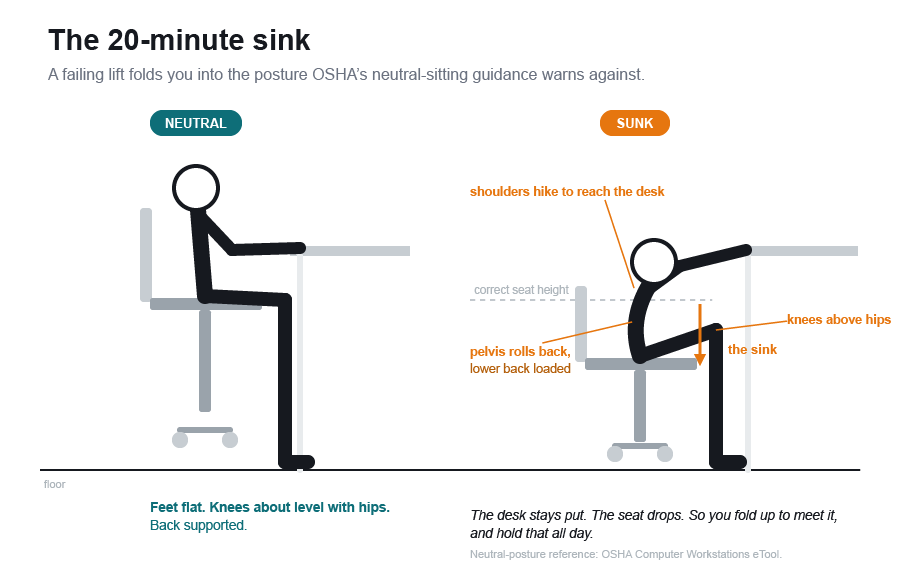
Here’s the worst part. You stop noticing. The drop is slow enough that your body adjusts to it before your brain does, so you spend six hours a day in a posture you’d never choose on purpose. By 3 PM your lower back is talking to you and you blame the long day, not the chair.
Why Cheap Office Chairs Sink: Class 2 vs Class 4
The part doing the lifting is a sealed gas cylinder: a tube of compressed nitrogen with a piston and a set of seals holding the pressure in. Every time you sit, that pressure holds you up. Every time those seals let a little gas slip past, you drop a bit lower.
Cylinders get graded Class 1 through Class 4. That distinction matters, because listings blur it on purpose: the grading comes from a German engineering standard called DIN 4550, not from any US body. So when a product page throws “BIFMA certified” and “Class 4” at you like they’re the same stamp, they’re measuring different things. The class is about how thick the steel is and how much load the cylinder is built to hold. BIFMA is a separate durability test.
Rough breakdown of what the classes actually mean:
Class 1 is throwaway. Thin wall, built for light loads under about 80 kg. The thing under a $40 chair.
Class 2 is the one that gets you. A little thicker, rated for loads under roughly 100 kg, and fine on paper. The problem is daily use. Put someone in it eight hours a day, adjusting it constantly, and the seals wear out sooner than the spec sheet implies. This is the budget manufacturer’s favorite, because it’s cheap and it passes a quick test in the showroom.
Class 3 is the sensible mainstream pick. Thicker steel, built around 150 kg.
Class 4 is the heavy one. Thickest wall and the best seals, rated well past 180 kg. It costs more, so budget chairs skip it.
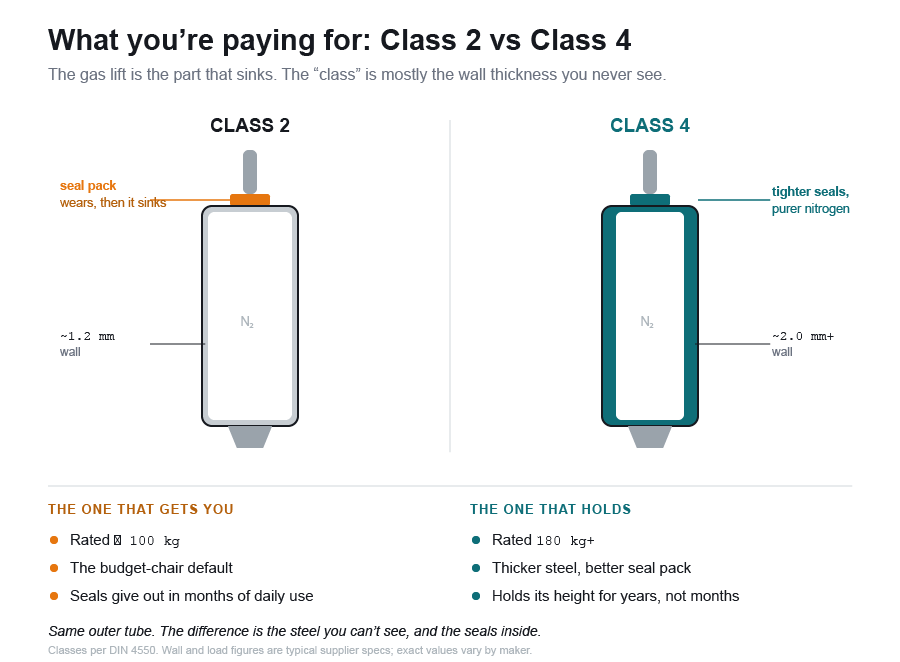
So why do the cheap ones use Class 2? Cost, mostly. I suspect it also survives the warranty window just often enough that the returns don’t hurt the maker. A Class 2 lift will usually get through its early life fine and then start leaking a few months in, right around the time you’ve stopped thinking about the receipt.
One myth to kill while we’re here. There’s a scare that floats around that a gas cylinder can blow and fire the piston up into you. It has happened, but you have to understand how rare it is: the cases that get cited trace back to uncertified, grey-market cylinders, and the one everyone points to is a death in China back in 2009. A cylinder with a real certification mark on the tube is not the thing to lie awake over. The sink is. And the sink almost never means the cylinder blew out in some dramatic way. It’s slow seal degradation, gas escaping past worn seals a little at a time, which is exactly why it feels gradual instead of sudden.
The weight trap
The data here is messier than the clean chart you’d expect, and more useful for it.
I read through a stack of complaints looking for the pattern everyone assumes exists: heavier person, faster sink, on some tidy timeline. It isn’t there in a way I’d put a number on, and I’m not going to invent one. What’s actually in the reviews splits into two piles, and both matter.
The heavy users mostly don’t report a slow sink. They report the chair breaking. On one popular budget chair, a reviewer around 230 lbs had the metal bracket between the seat and back warp inside three weeks. On another, someone under 160 lbs had the internal parts fail in under a week. That’s the frame giving out before the cylinder ever gets its turn, nothing to do with the gas lift.
The slow sink shows up more from average-weight people, and it usually means the cylinder was underbuilt from the start. The sharpest example I found: a 6’4″, 220 lb user on a sub-$200 desk chair said the lift started losing its hold after about a month and figured he’d be replacing it in six to nine. Another reviewer, who noted they weighed less than half the chair’s rated load, watched it sink and then jam stuck between the base and the seat inside the first hour. When a cylinder fails a light user that fast, weight had nothing to do with it.
So the useful takeaway isn’t a threshold chart at all. The class rating isn’t a pass/fail line for your body weight. It’s headroom. A lift rated for 100 kg doesn’t fail the second a 100 kg person sits down, it fails faster, because you’re running it at the top of its stress ceiling every day and the seals wear on a shorter clock the closer you sit to that ceiling. So don’t shop for a chair that “supports” your weight. Buy one rated well above it, so you sit in the comfortable middle of what the cylinder can do instead of riding its ragged top edge. From what the complaints suggest, that gap between your weight and the rated limit tells you more about how long the chair lasts than the price does.
The fix: don’t nurse it, replace it
You can swap a gas cylinder yourself. I’d think hard before you do, and I’m saying that after reading through a lot of people who tried.
The cylinder seats into the base and the seat mechanism on a tapered friction fit, no bolts, and after a year or two of your weight driving it in, that taper is seized on like it was welded. A couple of people are convinced the cheap ones literally are welded in. Whether that’s true or just how a fused taper feels, the result is the same. The removal threads read like a stress test. People go at these with a rubber mallet, then a sledgehammer, then a 24-inch pipe wrench, then penetrating oil left to soak overnight, then all of it at once over three days. One person destroyed two sets of pliers on a single cylinder. Another gave up on brute force entirely and drilled the housing out with a metal bit, then cut it off and pried the rest loose.
The manufacturers know it’s this bad. Their own removal videos hand you a pipe wrench and a hammer and, in one case, tell you to brace your foot on the wrench and put your bodyweight into it. One of them says the plain part out loud: on an older chair the cylinder can seem “almost fused into the chair” from long-term use. That’s the manufacturer talking, not me.
Two warnings before you pick up a tool. First, the grease. It’s black, industrial, and it does not come out of carpet or upholstery, and once the cylinder lets go it tends to go everywhere. Second, and this one matters more: the cylinder is a pressurized tube. Drilling or cutting into the wrong part of it is how you get hurt. If you didn’t already know which part is safe to touch, that’s the sign this isn’t your afternoon.
There’s also a shortcut people pass around for when you can’t get the old one out and just want the sinking to stop. You clamp a metal hose clamp tight around the exposed piston so it can’t drop. It works in the narrow sense that the chair holds its height. But you lose adjustment completely, you’re locked wherever you clamped it, and the clamp slowly chews into the housing. It’s a rigid patch on a part that’s already dead.
The real answer is the boring one. A blown cheap cylinder almost always means the chair was built cheap everywhere else too, so you’re likely replacing the whole thing inside the year regardless of how the swap goes. Buy the heavy lift up front. A chair with a Class 4 cylinder and a solid base costs you more once, instead of costing you a sore back, a replacement part, and a weekend on the floor with a sledgehammer and a carpet full of grease. The people I read who finally spent the money on a properly built chair all say a version of the same thing afterward: they wish they’d done it two years sooner.
We put the picks that clear this bar in our Best Chairs Under $300 guide. Every chair on that list runs a lift that won’t have you reaching for the lever by lunch.